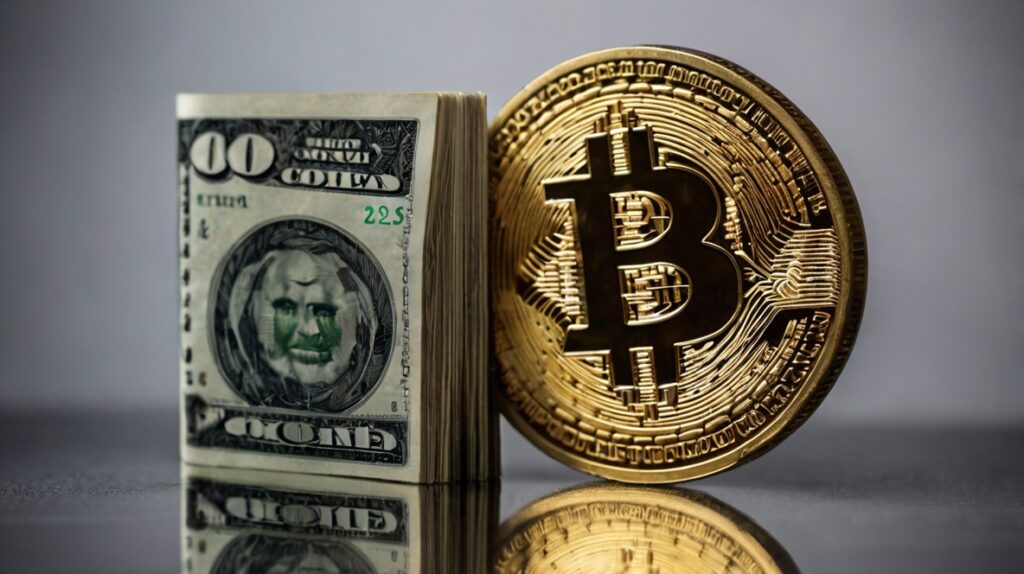
Why Bitcoin Could Be the Future of Money
Introduction: Bitcoin’s Disruptive Potential in the Global Financial System
Since its inception in 2009, Bitcoin has challenged the traditional concept of money, raising questions about the future of finance. Its decentralized nature, and its technological innovations have many wondering if it could be the Bitcoin future of money. This article explores the reasons why Bitcoin has the potential to revolutionize the global financial system, its impact on cryptocurrency adoption, and how it offers a compelling vision for the future of digital currency.
Limitations of Traditional Financial Systems
To understand Bitcoin’s potential as the future of money, it’s essential to understand the problems with current financial systems. These limitations have created a need for a better system, and are what makes Bitcoin so compelling.
Centralized Control
Traditional currencies are controlled by central banks and governments, which have the power to manipulate monetary policy. This centralized control is a weakness, as it can be influenced by politics and corruption.
High Transaction Fees
Traditional financial systems often charge high fees for international money transfers and also credit card processing, making transactions more expensive for businesses and consumers. This is a constant pain point for many users of these systems.
Slow Processing Times
Traditional bank transfers and payment systems often take days, or sometimes even weeks to complete. This is due to a complex web of intermediaries, which make the whole process slow.
Lack of Transparency
Traditional systems often lack transparency, making it difficult for users to track their transactions or know where their money is at any given time. This can create confusion and also a lack of trust.
Financial Exclusion
Many individuals around the world lack access to traditional banking services, which excludes them from participating in the global economy.
Bitcoin’s Properties as a Decentralized Currency
Bitcoin was created to be an alternative to traditional systems, and it is designed to solve many of the problems of these centralized systems. Bitcoin has key characteristics that make it very compelling as a future currency.
Decentralization
Bitcoin is decentralized, with no single entity or central authority controlling the network. This gives more power to the users of the network, making it more resilient to manipulation.
Peer-to-Peer Transactions
Bitcoin allows for direct peer-to-peer transactions, without the need for intermediaries. The elimination of middlemen makes transactions more efficient.
Limited Supply
Bitcoin has a fixed supply of 21 million coins, which can not be changed. This creates a digital scarcity, making it a more reliable store of value over time.
Transparency
All Bitcoin transactions are recorded on a public blockchain, making the system transparent and auditable. This transparency also provides a high degree of security.
Accessibility
Bitcoin is globally accessible to anyone with an internet connection, making it a more inclusive financial system, than the current one.
Bitcoin’s Role as a Medium of Exchange
For a currency to be successful, it must function as an effective medium of exchange. Bitcoin has key attributes that make it useful for making transactions on a daily basis. The growth of e-commerce and also cross-border commerce makes Bitcoin a very practical alternative.
Digital Payments
Bitcoin enables fast and easy digital payments, without the need for credit cards or bank transfers, and these can be sent to anyone all over the world.
Cross-Border Transactions
Bitcoin facilitates fast and low cost cross-border transactions, making it a good option for international payments and remittances.
Microtransactions
Bitcoin is divisible into smaller units, making it suitable for microtransactions and also small online payments, which opens up a lot of new possibilities.
Reduced Fees
Bitcoin transactions have lower fees compared to traditional payment systems, making them more appealing for everyday use.
Bitcoin as a Store of Value
For a currency to be effective, it must also function as a reliable store of value. Bitcoin’s limited supply, and its decentralization make it a very strong contender as a store of value. The fact that it cannot be manipulated by any central authority, makes it an appealing option for storing your wealth.
Hedge Against Inflation
Bitcoin has the potential to act as a hedge against inflation, protecting purchasing power over time. As more governments print money, Bitcoin may be a good alternative store of value.
Digital Scarcity
Bitcoin’s limited supply creates digital scarcity, which is very important for a digital asset, that can be duplicated an infinite amount of times. The fact that Bitcoin is scarce, is what gives it value.
Long-Term Investment
Many see Bitcoin as a long-term investment, similar to gold, with the potential for significant value appreciation over time.
Decentralized Alternative
Bitcoin offers a decentralized alternative to traditional stores of value, such as gold, and is not controlled by any central authority, and also has the benefit of being easily transported and stored.
The Impact of Cryptocurrency Adoption
The adoption of Bitcoin by individuals, businesses, and institutions, will play a critical role in its ability to become the future of money. Increasing adoption is key to the success of Bitcoin and any cryptocurrency.
Retail Adoption
As more people begin to use Bitcoin in their daily lives for payments and transactions, the closer it will get to achieving its potential.
Business Adoption
As more businesses begin to accept Bitcoin for products and services, its practical use will increase, which is also very important to widespread adoption.
Institutional Adoption
Institutional adoption will help to bring more legitimacy to Bitcoin, and the entire cryptocurrency space. Institutions have very large sums of capital, and this adoption is essential.
Growing Awareness
Increased awareness of Bitcoin and its potential benefits, can help more people understand its value proposition. Education is key to increasing adoption.
Bitcoin’s Potential to Enhance Financial Inclusion
One of the most compelling aspects of Bitcoin, is its potential to enhance financial inclusion, by providing banking services to underserved populations.
Access to Financial Services
Bitcoin provides access to financial services for individuals who are excluded from traditional banking systems.
Cross-Border Transactions
Bitcoin allows for low-cost international money transfers, benefiting migrant workers and also their families.
Microfinance Opportunities
Bitcoin can also facilitate microfinance and lending, providing opportunities for economic development in developing countries.
Empowering Individuals
Bitcoin can empower individuals by giving them more control over their money and their own finances.
Technological Advantages of Bitcoin
Bitcoin also provides technological advantages, that make it a compelling alternative for the future of money.
Blockchain Technology
Bitcoin is built on blockchain technology, which is a secure and transparent ledger system. This underlying technology is what gives Bitcoin its advantages.
Cryptography
Bitcoin uses cryptography to secure transactions and to prevent any fraud or manipulation. This security is what makes it a safe and secure way to transfer value.
Decentralized Network
Bitcoin’s decentralized network makes it more resilient to censorship and also to attacks.
Programmability
While Bitcoin’s programming capabilities are limited, new developments are continuously adding new capabilities, such as Taproot, and also smart contracts.
Challenges and Obstacles to Widespread Adoption
Despite its potential, Bitcoin faces several challenges and obstacles that must be addressed to reach full mainstream adoption.
Scalability
Bitcoin’s scalability limitations are a major challenge that is currently being addressed through new technology and also layer 2 solutions, such as the Lightning Network.
Volatility
Bitcoin’s price volatility can be a major deterrent for mainstream adoption, however, as the market matures this is likely to stabilize.
Regulation
The uncertainty around global regulation can create confusion and barriers to entry for many users. This remains one of the major points of contention for many.
Complexity
The technology surrounding Bitcoin is complex, and many people may find it difficult to understand. More educational resources, and simpler systems are needed to bring it to the masses.
The Future of Bitcoin: A Vision for a Decentralized World
The future of Bitcoin as a digital currency is still evolving. There is the possibility of Bitcoin becoming a fully integrated part of the global financial system, making it the Bitcoin future of money.
Mainstream Acceptance
As Bitcoin becomes more accepted by businesses, governments, and institutions, it will become a more viable alternative to traditional forms of money. Mainstream acceptance is one of the most important factors for any successful currency.
Technological Advancements
Technological improvements will address challenges such as scalability, and also improve user experience. These advancements are always being worked on by the Bitcoin community.
Decentralized Financial System
Bitcoin has the potential to create a more decentralized, transparent, and also equitable global financial system. This change in the financial system can create many opportunities for growth.
Global Adoption
As Bitcoin becomes more accessible, and also more understood by more people, adoption will continue to grow in all parts of the world. Global adoption is the key to success.
Conclusion: A Paradigm Shift in How We Think About Money
Bitcoin’s journey has shown that it has the potential to be a transformative force in the world of finance. Its unique features, including decentralization, transparency, and digital scarcity, make it a compelling alternative to traditional currencies. The potential for greater cryptocurrency adoption, and its technological innovations, suggest that Bitcoin could very well be the Bitcoin future of money, representing a paradigm shift in how we think about value, and also how we handle our money. Although challenges remain, its potential to shape the future of the global economy is undeniable.